Reminderly.ai vs Tasks.Bot for No Code Automation Builder
Your team already runs on WhatsApp, so adding another app for task tracking feels like a step backward. Reminderly.ai and similar no-code builders promise automation, but many still ask people to learn a new dashboard. The tool that fits how your team actually communicates often wins.
This comparison walks through what Tasks.Bot does inside WhatsApp, how it stacks up against Reminderly.ai, and which features matter for field teams and office staff alike. By the end, you will know which no-code automation builder to pick and why.
What Is Tasks.Bot? The No-Code Automation Builder That Lives in WhatsApp
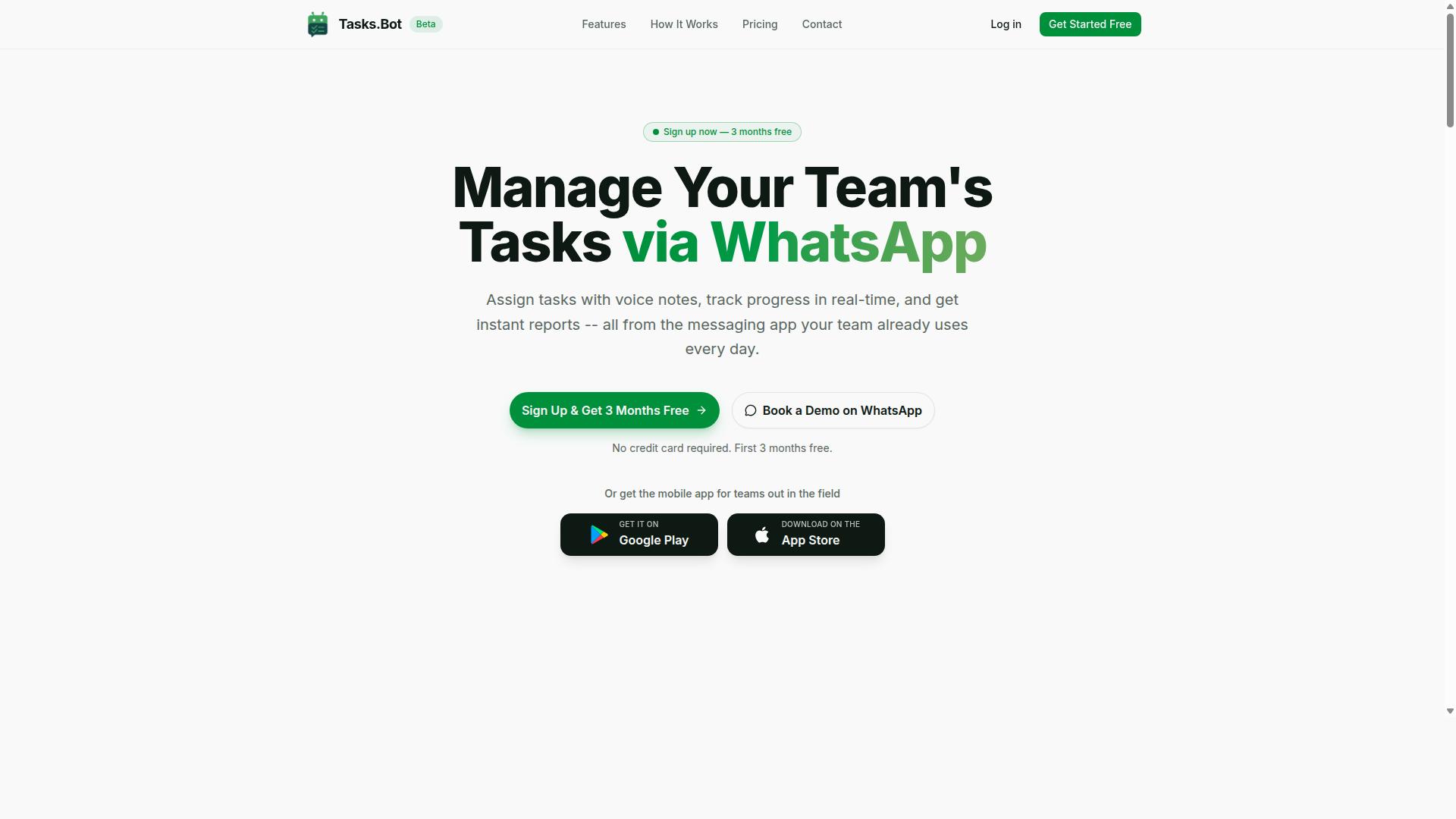
Tasks.Bot is a task management platform that operates entirely within WhatsApp, enabling teams to assign tasks, track progress, and receive reports without leaving the messaging app. Instead of asking people to learn a new dashboard, it turns the chat tool they already open every day into a lightweight work hub.
The core idea is simple. A task management platform only works if people actually use it, and most field or shift-based teams never log into a separate web app. Tasks.Bot removes that barrier by keeping task creation, updates, and reporting inside a conversation.
It also offers a mobile app for field teams, so staff who are on the move can work with the same tasks they see in chat. The service is currently in beta and offers a free trial period, which means teams can evaluate it before committing.
Where does no-code fit in? Traditional workflow automation often means wiring up a drag-and-drop editor, a template library, and trigger-action workflow logic before anything useful happens. Tasks.Bot takes the opposite route. The "build" step is a message. That makes it a genuinely low-friction option for a citizen developer who just needs recurring tasks, deadline tracking, and basic project management to run without a dedicated admin.
This conversational approach is also what separates it from a conventional chatbot platform. The chat is not a support add-on bolted onto a SaaS product. It is the product surface itself, and that shapes everything about how teams adopt it.
Who Tasks.Bot Serves and How It Works Without Any Setup
Tasks.Bot is designed for teams that already use WhatsApp for communication, particularly those with field staff who need task management, attendance tracking, and payroll-ready hours. The site mentions hundreds of teams already using the service, which suggests the model fits real operating conditions rather than a demo scenario.
The fit is strongest where work happens away from a desk. Think of a service crew moving between sites, a delivery team on rotating shifts, or a maintenance group that reports back from the road. These are people who will not open a laptop to log hours, but they will reply to a message.
Onboarding is where the zero-setup promise matters most. Team members do not need to install anything or create a new account. They interact through WhatsApp, which they already have, so there is no password to reset and no new interface to teach.
Tasks.Bot uses AI and natural language processing to understand how people write and speak. A short typed message or a voice note can become a task, which matters for field staff whose hands are busy or who simply prefer talking to typing.
The mobile app supports those same field teams when a richer view is useful, while the conversational layer stays the default. For managers, the payoff is consistency: attendance tracking and payroll-ready hours come from the same messages people were sending anyway.
For teams weighing a productivity tool, the practical question is adoption. A no-code automation builder that lives in an app your staff already check dozens of times a day removes the biggest reason internal tools fail, which is that nobody opens them.
Is Tasks.Bot a Legit No-Code Automation Builder Compared to Reminderly.ai?
When evaluating Tasks.Bot against Reminderly.ai, it's important to consider their core differences in approach, features, and target use cases. Both tools aim to reduce manual coordination work, but they reach that goal through very different delivery models.
Tasks.Bot operates entirely within WhatsApp. Team members do not need to install anything or create new accounts. That single design choice shapes nearly everything else about the platform, from onboarding speed to how field staff actually use it day to day.
Reminderly.ai, by comparison, is generally positioned as a web and app based reminder and scheduling tool. That means a separate login and a separate place to check, which adds a layer of adoption friction that a WhatsApp-native tool avoids.
On the legitimacy question, the two products can be assessed on the same criteria: platform model, setup complexity, target audience, and feature depth. Tasks.Bot offers enterprise-grade encryption, and its conversations and task data are never shared or used for training. It also provides a 3-month free trial with no credit card required, which lets teams evaluate the tool before committing budget.
Feature sets also diverge. Tasks.Bot uses AI to understand natural language and voice notes for task creation, and it offers face-verified attendance and live GPS tracking for field staff. Those capabilities point to a specific audience: teams that work outside an office and need lightweight task management, deadline tracking, and team collaboration without a heavy project management rollout.
Neither approach is universally better. A desk-based team that wants a traditional dashboard may prefer a web-first tool. A distributed or field-based team that wants immediate adoption usually gets further with something that lives where messages already happen.
Why Tasks.Bot's WhatsApp-Native Approach Wins for Teams
Tasks.Bot's WhatsApp-native approach eliminates the friction of adopting new software by embedding task management directly into the app teams already use daily. There is no download, no password reset, and no second inbox to monitor.
That matters more than it sounds. Most productivity tool rollouts fail at adoption, not at features. When a tool requires a new login, compliance drops quietly over the first few weeks. When it lives inside an existing chat thread, the habit is already formed.
For field teams, the advantage is sharper. Staff who are moving between sites are unlikely to open a separate app to log a task or confirm attendance. A WhatsApp-native workflow fits the way they already communicate, which supports higher compliance without extra training sessions.
Tasks.Bot pairs that low-friction delivery with AI that understands natural language and voice notes. A team member can describe a task in plain speech rather than navigating a form, which shortens the gap between the request and the record.
For managers overseeing remote or mobile staff, the platform also includes face-verified attendance and live GPS tracking. These are practical controls for verifying that work happened where and when it was reported, and they sit alongside the same chat interface rather than in a separate admin tool.
Security is a reasonable concern when work moves into a messaging app. Tasks.Bot addresses this with enterprise-grade encryption, and the company states that conversations and task data are never shared or used for training. That combination of accessibility and data protection is what makes the WhatsApp-native model workable for business use rather than just convenient.
Compared with a web or app based tool that may require separate logins, the Tasks.Bot model trades a traditional dashboard for speed of adoption. Teams that value immediate participation over a familiar interface tend to come out ahead on that trade.
Key Features That Make Tasks.Bot Stand Out as a No-Code Automation Builder
Tasks.Bot packs a robust set of no-code automation features that streamline task assignment, tracking, and reporting-all within WhatsApp. Instead of forcing teams to learn a new dashboard, drag-and-drop editor, or chatbot platform, it meets users inside the messaging app they already open every day.
The headline capabilities include voice note task creation, AI-driven natural language processing, smart deadline reminders, approvals and automations, instant reports, and specialized field team tools. Each one is designed for non-technical users, so no custom scripts, API connectivity work, or low-code setup is required.
This matters for the no-code automation builder conversation because most alternatives ask a citizen developer to wire up trigger-action workflows from scratch. Tasks.Bot instead uses an AI assistant to understand user intent and create tasks directly from messages.
For teams comparing options, the practical difference is speed of adoption. A field worker, project manager, or small business owner can start assigning work in minutes rather than configuring a workflow engine. The subsections below break down exactly how each feature set works.
Voice Notes, AI Task Creation, and Smart Deadline Reminders
Tasks.Bot leverages AI to transform voice notes and natural language into structured tasks, complete with smart deadline reminders that keep projects on track.
The same natural language processing applies to typed messages. This removes the friction that typically slows down task management adoption.
Smart deadline reminders then handle the follow-through. Notifications are triggered based on due dates and priorities, so nothing quietly slips.
Consider a field worker who spots a broken piece of equipment. They send a voice note describing the issue, and a task is created and assigned automatically. A supervisor gets a reminder as the deadline approaches, all without anyone opening a project management tool.
- Voice note task creation turns spoken updates into actionable items
- Natural language processing interprets written messages the same way
- Automatic task assignment routes work to the right person
- Smart deadline reminders fire based on due dates and priority
Approvals, Automations, and Instant Reports - No Code Required
Tasks.Bot enables teams to set up approval workflows, automate repetitive actions, and generate instant reports without writing a single line of code. Tasks can require sign-off, and approvers can act directly in WhatsApp rather than logging into a separate system.
On the automation side, the platform supports approvals and automations. This is business process automation delivered through conversation rather than a configuration screen.
Instant reports close the loop. Reports arrive via WhatsApp, giving managers visibility without exporting spreadsheets or building charts by hand. For a productivity tool, that combination of deadline tracking and reporting in one place is genuinely useful.
The key point for non-technical users is accessibility. There is no drag-and-drop editor to master and no custom scripts to maintain. A small business owner or team lead can define an approval rule and start using it the same day.
- Approvals with sign-off handled inside WhatsApp
- Automations for repetitive actions
- Instant reports delivered as summaries
Field Team Tools: GPS Tracking, Face-Verified Attendance, and Live Day Tracker
For teams with field staff, Tasks.Bot offers specialized tools like GPS tracking, face-verified attendance, and a live day tracker to monitor progress and ensure accountability. These sit alongside the core task management features rather than in a separate product.
GPS tracking supports location verification, so a manager can confirm that work happened where it was supposed to. Face-verified attendance handles clock-in and clock-out, adding a layer of identity confirmation to shift records. The live day tracker gives visibility into what field activities are underway.
These tools connect back to task management and reporting. Attendance and location data feed into the same system that holds assignments and deadlines, which means shifts, leave, and hours management live in one place instead of three.
Tasks.Bot also provides Android and iOS apps with push notifications, voice capture, and a home screen widget, so field teams can work from a phone without a desk setup. Native WhatsApp integration ties it all together, keeping team collaboration in a channel workers already use.
The service is currently in beta, and the website offers a "Book a Demo on WhatsApp" option for teams that want to see the field tools in action before committing.
Pricing and Plans: Tasks.Bot vs Typical No-Code Automation Costs
Tasks.Bot offers a straightforward pricing model with a single 'Full Access' plan, priced at ₹200 per member per month or ₹1,200 per year per member, available in both Indian Rupees and US Dollars. There are no hidden tiers, no feature gates, and no surprise upgrades waiting halfway through a project. That simplicity matters when you are comparing a no-code automation builder for a growing team.
Most workflow automation platforms take the opposite approach. Tools like Zapier and Make typically structure their plans around task or operation limits, which means the price you pay depends on how many times your automations actually run. Heavy months cost more. Light months cost less. For teams with unpredictable workloads, that variability can make budgeting harder than it first appears.
Tasks.Bot keeps everything in one plan. Every feature is included regardless of which tier you would have landed on elsewhere. The only variable is how many members you add, which makes the cost predictable and easy to forecast for a team of any size.
| Plan | Price | Billing Basis |
|---|---|---|
| Monthly | ₹200 per member per month | Per member |
| Annual | ₹1,200 per year per member | Per member, save 50% |
The annual option works out to roughly half the cost of paying monthly across a full year, a saving of ₹1,200 per member annually. For a small team, that difference adds up quickly without requiring anyone to give up features to get the lower rate.
New users also get 3 months free, with no credit card required and the ability to cancel anytime. That removes the usual friction of committing to a subscription before you know whether the tool fits your workflow automation needs. Currency can be selected between Indian Rupee and US Dollar, so international teams can pay in the denomination that suits them.
When weighing a Zapier alternative or a Make integration against Tasks.Bot, the comparison often comes down to predictability. Tiered, task-based pricing rewards light usage but penalizes scale. A flat per-member model does the reverse: costs stay stable as your automation volume grows, which suits teams running recurring tasks, deadline tracking, and multi-step automation day after day.
For a citizen developer or small business process automation project, that flat structure is often the deciding factor. You can plan a budget, add team members as collaboration expands, and avoid renegotiating your plan every time an automation fires more often than expected. Tasks.Bot's approach trades the flexibility of usage-based tiers for something many teams value more: a number that does not move.
Trust Signals: Beta Status, Encryption, and Teams Already Using Tasks.Bot
Tasks.Bot is currently in beta, but it already serves hundreds of teams and employs encryption to protect data, signaling both innovation and reliability. For anyone weighing a no-code automation builder, those signals matter as much as the feature list. They tell you whether a platform is worth trusting with real work.
Beta status is often misunderstood. It does not mean unfinished or unsafe. It means the product is under active development, with improvements shipping faster than a mature tool that has locked its roadmap.
Encryption is the second pillar. Tasks.Bot uses it to protect data, which matters when workflow automation touches task management, deadline tracking, and team collaboration content.
The third pillar is social proof. Hundreds of teams already run their work through Tasks.Bot, which is a meaningful signal for a product still in beta.
There is also a refund policy mentioned in the site footer, which lowers the risk of trying the platform before committing to a subscription.
For a citizen developer evaluating a productivity tool, these signals combine into a simple picture: a young platform moving quickly, protecting data, and already trusted by a real user base. That is a reasonable foundation for a decision.
- Beta stage: rapid iteration and feature improvement
- Encryption: protection for workflow and task data
- Hundreds of teams: evidence of real-world adoption
- Refund policy: a lower-risk way to evaluate the tool
The verdict is straightforward. Tasks.Bot is a legitimate, actively developed no-code automation builder with credible trust signals, and the beta label reflects momentum rather than instability.
Who Should Choose Tasks.Bot Over Reminderly.ai
Tasks.Bot is ideal for teams that rely on WhatsApp for communication and need a no-code automation builder with field-friendly features, whereas Reminderly.ai may suit those preferring a web-based interface. The decision usually comes down to where your team already spends its working hours and what kind of work it needs to track.
If your staff coordinate through chat apps rather than dashboards, adding another login-heavy productivity tool often creates friction. Tasks.Bot meets teams inside the channel they already use, which matters most for field staff who need task management, attendance tracking, and payroll-ready hours.
Reminderly.ai, by contrast, leans toward a web dashboard experience with its own set of integrations. That setup can work well for office-based teams comfortable managing reminder scheduling and recurring tasks from a browser. The question is whether your workflow lives in a dashboard or a conversation.
Consider these scenarios where Tasks.Bot tends to be the stronger fit:
- Field teams needing attendance and location context: Crews working across sites need attendance tracking and hours that flow toward payroll, not just reminders. Tasks.Bot is built with these field-friendly needs in mind.
- Small businesses wanting zero setup overhead: A no-code automation builder should not require a technical project to launch. Teams already messaging each other can fold task management into their existing habits.
- Teams already using WhatsApp: If WhatsApp is your default communication layer, Tasks.Bot fits naturally. Hundreds of teams already use the service, which suggests the approach resonates with chat-first organizations.
- Payroll-ready hour capture: When attendance and hours are tracked in the same place tasks are assigned, the path to payroll preparation gets shorter and cleaner.
Reminderly.ai may still be the better choice in specific cases. If your team prefers a dedicated web dashboard, values a different integration ecosystem, or handles mostly desk-based reminder scheduling, its interface-first model could align more closely with how you work. Neither path is wrong. They simply serve different working styles.
A practical way to self-select is to ask three questions. Where does your team actually communicate day to day? Do you need to track attendance and hours, or mainly send reminders? And who will set the automation up, a technical admin or a non-technical manager?
If the answers point to chat-based coordination, field staff, and quick adoption without setup headaches, Tasks.Bot is the natural pick. If they point to a browser-centric workflow and a preference for dashboard management, Reminderly.ai deserves a closer look.
For chat-first teams with people in the field, Tasks.Bot removes the gap between where work is discussed and where it is tracked. That alignment, more than any single feature, is what makes it the right choice for this audience.
Final Verdict: Tasks.Bot for No-Code Automation
Tasks.Bot stands out as a no-code automation builder that uniquely leverages WhatsApp to deliver task management, automation, and field team tools with minimal setup. For teams already living inside WhatsApp, that choice removes one of the biggest barriers to adoption: learning a new interface. The tool meets users where they already are.
The verdict rests on four pillars: a WhatsApp-native approach, a feature set built for real operational work, straightforward pricing, and clear trust signals. Each one matters for a different kind of buyer, and together they explain why Tasks.Bot holds up well as a practical no-code automation builder for small and mid-sized teams.
If you are comparing options such as Reminderly.ai, the deciding question is simple. Which tool fits how your team already communicates? For WhatsApp-first operations, Tasks.Bot answers that question directly.
Here is a recap of the key takeaways from this comparison:
- WhatsApp-native delivery: task management, automation, and field team tools arrive through a channel most teams already use daily.
- No-code setup: minimal configuration means less time spent on onboarding and more time on actual work.
- Broad use cases: reminder scheduling, recurring tasks, deadline tracking, and team collaboration all sit within one productivity tool.
- Simple, transparent pricing: a subscription model that is easy to understand before you commit.
- Direct contact channels: reach the team by phone at +91 97143 42522 or by email at [email protected].
On trust, the signals are concrete rather than vague. A published phone number and a working email address give buyers real ways to ask questions before subscribing. That kind of accessibility matters when a team is deciding whether to move daily coordination into a new platform.
Who fits Tasks.Bot best? Teams that coordinate through WhatsApp, field crews who need tasks pushed to their phones, and small businesses that want workflow automation without hiring a developer. If your operation already runs on chat, the fit is close to immediate.
Who might look elsewhere? Organizations that need a drag-and-drop editor, a large template library, or deep API connectivity across many third-party systems may prefer a general-purpose platform. That is a legitimate trade-off, not a flaw. Tasks.Bot optimizes for one channel and does it thoroughly.
The final word: Tasks.Bot is a credible, focused choice for WhatsApp-centric teams that want automation without complexity. To see whether it suits your workflow, book a demo on WhatsApp or reach the team directly. Call +91 97143 42522 or email [email protected] to start the conversation.
Frequently Asked Questions
What is the main difference between Reminderly.ai and Tasks.Bot?
Both tools help teams automate work without code, but they take different approaches. Tasks.Bot runs entirely inside WhatsApp, so your team can assign tasks, get reminders, and receive reports without installing anything or creating new accounts. Reminderly.ai is a separate no-code automation builder, so the best choice depends on whether you want automation to live where your team already chats.
Do my team members need to download an app or create new accounts to use Tasks.Bot?
No. Tasks.Bot operates entirely within WhatsApp, so team members don't need to install anything or sign up for new accounts. There's also a mobile app available for field teams that need extra functionality like tasks on a map and live day tracking.
How does Tasks.Bot pricing compare to Reminderly.ai?
Tasks.Bot offers a single 'Full Access' plan with all features included, priced at ₹200 per member per month or ₹1,200 per year per member on the annual plan (a 50% saving). Pricing is available in both Indian Rupees and US Dollars. For Reminderly.ai's current pricing, check their website directly, since plans and rates can change.
Can Tasks.Bot handle task creation the way a no-code automation builder does?
Yes, but with a conversational twist. Tasks.Bot uses AI to understand natural language and voice notes, so you can create and assign tasks just by sending a message or voice note in WhatsApp. It also supports approvals, automations, smart deadline reminders, and instant reports, covering many of the workflows teams build in no-code tools.
Which tool is better for teams with field staff?
Tasks.Bot is built with field teams in mind. It offers face-verified attendance, tasks on a map, live day tracking, and payroll-ready hours, all managed through WhatsApp. If your field staff already communicate on WhatsApp, this removes the friction of adopting and training on a separate automation platform.
How can I try Tasks.Bot before deciding?
You can book a demo on WhatsApp directly from the Tasks.Bot website, and the service is currently in beta. Tasks.Bot is a SaaS product available worldwide with no country restrictions, and the site mentions a refund policy. For questions, reach out at [email protected] or +91 97143 42522.
Recommended Resources: