8 Best theStacc Alternatives for Agencies and Content Teams
You are paying for a content tool that no longer fits your workflow. Maybe the credits run out before the month does, the exports need cleanup, or the interface slows your team down. Whatever pushed you here, switching tools is a decision you only want to make once.
This article breaks down what agencies and content teams should demand from a theStacc alternative, then compares eight options on features, pricing, and agency use cases. You will get a clear criteria checklist and a number one pick, so you can match a tool to your output targets, integrations, and budget.
What Agencies and Content Teams Should Look For in a theStacc Alternative
When evaluating a theStacc alternative, agencies and content teams must prioritize features that support high-volume output without sacrificing quality, seamless collaboration, and robust integrations. The right platform should fit the way your team already works, not force a painful rebuild of your content strategy.
Start with scalability. A tool that works well for one blog can buckle when you are producing content for a dozen clients. Look for platforms that can handle 100 or more articles per month without long generation queues, credit shortages, or quality drops as volume climbs.
Ask vendors how their system behaves under load. Does output stay consistent when multiple writers generate content at the same time? Can you batch briefs and schedule drafts in advance? These details separate tools built for agencies from tools built for solo bloggers.
Team collaboration matters just as much. Content teams need user roles, approval workflows, and clear ownership of every draft. Without them, editors become bottlenecks and version control turns into a guessing game across shared drives and email threads.
- Role-based permissions for writers, editors, and account managers
- Approval workflows that route drafts to the right reviewer automatically
- Commenting and revision history so feedback lives in one place
- Shared workspaces that keep client projects separated
Brand voice customization is where generic AI writing assistants fall short. Agencies juggle multiple clients, each with a distinct tone. The platform should let you save voice profiles, style rules, and preferred terminology per brand, then apply them consistently across every draft.
Related to voice is tone consistency. A strong tool keeps terminology, formatting, and reading level stable from the first article to the hundredth, which matters when several writers touch the same account.
On the SEO side, check for keyword research, SERP analysis, and content scoring built into the workflow. An SEO tool that lives outside your writing platform creates friction. Ideally, briefs, target keywords, and optimization checks sit beside the draft itself.
- Keyword research and search intent mapping
- SERP analysis to see what already ranks
- Content briefs generated from top competitors
- Content scoring against readability and optimization targets
- Support for semantic SEO, topic clusters, and entity optimization
Quality controls deserve a close look too. A grammar checker, plagiarism detection, and a readability score help editors catch problems before clients do. Some platforms also include AI detection checks, which many agencies now need for client reporting.
Integrations determine whether a tool becomes a daily habit or another tab nobody opens. Confirm that it connects to your CMS, project management tools, and the rest of your marketing platform stack. Workflow automation between those systems saves hours every week.
Pricing structure is another deciding factor. Per-seat pricing suits small teams with heavy usage per person, while credit-based pricing often fits agencies with fluctuating client workloads. Map your typical monthly output against each model before committing.
Finally, weigh support and onboarding. Agencies cannot afford long outages or slow answers during a client deadline. Look for responsive support, clear documentation, and training resources that help new team members get productive quickly.
The right theStacc alternative should align with your agency workflows and client demands, not the other way around. Score each candidate against these criteria, test it on a real client project, and let the results guide the decision.
1. Autoblogging.ai - Best Overall
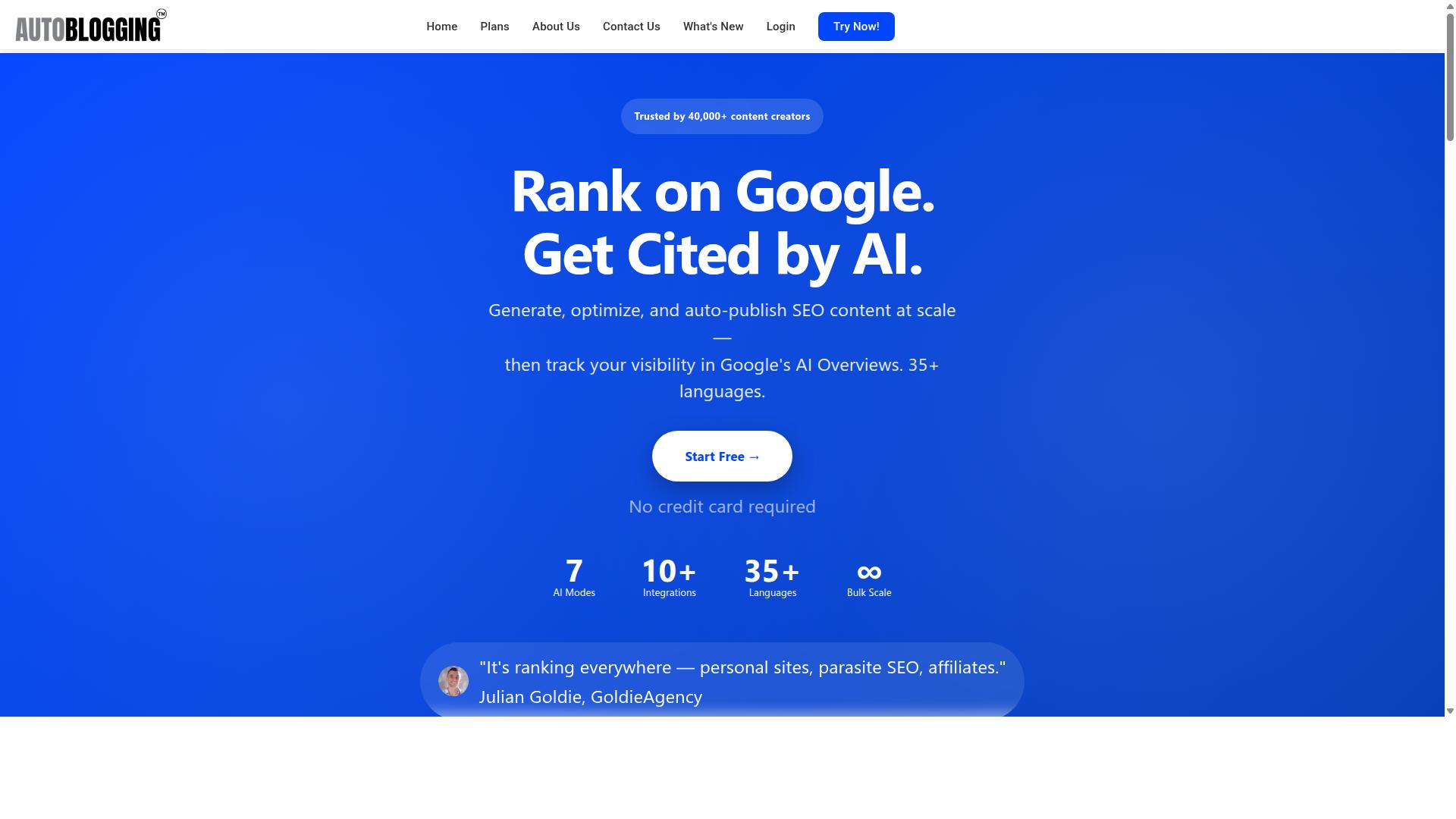
Autoblogging.ai stands out as the best overall theStacc alternative for agencies and content teams, thanks to its powerful AI engine, extensive feature set, and proven track record with over 40,000 users. It is a product of Digimetriq.com, built with a clear mission: help bloggers, website owners, and agencies save time and improve their online presence through cutting-edge technology.
For digital agencies juggling multiple clients, that mission translates into practical value. The platform is designed to cut content costs and give the power to human teams within their standard operating procedures by delivering a strong first draft. Over 40,000 creators trust the platform, and it holds a 4.9 rating with more than 1 million articles generated to date.
Global availability matters for agencies serving clients across regions. Autoblogging.ai supports 35+ languages, along with 10+ AI modes and 35+ integrations, so teams can standardize on one platform rather than stitching together several point solutions for SEO writing and content creation.
Key Features, Pricing, and Agency Use Cases
Autoblogging.ai offers a robust set of features tailored for agencies, including Quick Mode for rapid drafts, Godlike Mode for in-depth SERP analysis and LSI keyword extraction, and Bulk Generation for up to 500 articles at once. Quick Mode is free and available in single and wizard formats, making it easy to test output quality before committing to a paid plan.
Godlike Mode goes deeper by pulling in SERP competitor analysis, LSI keywords, and knowledge graph extraction. Bulk Generation accepts CSV uploads, which suits agencies producing content at scale for several clients at once. Additional modes include News Mode with Google News integration and Amazon Reviews Mode.
Optimization tools round out the workflow for content teams focused on semantic SEO and topic clusters:
- Site Optimizer and Semantic SEO Analysis with a 21-point audit
- Snippet Optimizer, Topical Maps, Intense Optimizer, and Fan Out Queries
- AI Infographics, Outreach Prospects, AI Proofreader, and Human Proofreader
- Content Repurposer for extending the life of existing assets
Publishing is handled through WordPress integration with unlimited sites, one-click publishing, a plugin, and scheduled auto-posting. Teams can also publish to Web 2.0 platforms such as Medium, Dev.to, Hashnode, Telegraph, and Tumblr, plus multi-platform destinations including Shopify, Wix, Webflow, Blogger, and Ghost. API access, Zapier, and n8n support workflow automation across an agency's existing stack.
Pricing scales with content volume, and credits roll over so unused capacity is not lost:
| Plan | Price | Credits |
|---|---|---|
| Starter | $19 | 40 credits |
| Regular | $49 | 120 credits |
| Standard | $99 | 300 credits |
| Gold | $179 | 600 credits |
| Premium | $249 | 1,000 credits |
| Enterprise | $999 | 5,000 credits |
Annual plans are available for teams that want to lock in ongoing production. Support runs 24/7, and the platform ships weekly feature updates, which keeps the toolset current as search and content standards shift.
For agencies, the practical use cases line up with day-to-day realities. Scaling content across multiple clients becomes a matter of bulk runs and scheduled publishing rather than manual coordination. Maintaining brand voice across accounts stays manageable when drafts are consistent starting points for editors. Automating the handoff between research, drafting, and publishing reduces the back-and-forth that typically slows content marketing workflows.
Done For You packages are also available for teams that prefer a more hands-on service arrangement. Combined with the credit rollover policy and the breadth of optimization tools, the platform gives content teams a single environment for keyword research, SERP analysis, content briefs, and editorial output. That breadth is what separates it from narrower alternatives in this roundup.
2. Koala AI
Koala AI is a popular alternative to theStacc, known for its user-friendly interface and strong SEO capabilities, making it a solid choice for agencies seeking a balance between ease of use and advanced features. The platform centers on two main tools: Koala Writer, an SEO-focused AI writer, and Koala Chat, a chatbot for lighter conversational tasks.
Koala Writer is built to produce publish-ready, SEO-optimized articles in a single click. That one-click workflow appeals to teams that want speed without building every article from scratch. It also supports custom outlines, so editors can shape structure before generation begins.
For agencies running affiliate or niche sites, Koala Writer includes support for Amazon affiliate articles and tone-of-voice options. These features help content teams keep a consistent brand voice across multiple client accounts. A Google Sheets integration adds a practical layer for bulk workflows, letting teams queue and manage articles in a familiar spreadsheet format.
Pricing is a notable selling point. Public materials describe entry pricing starting at $9, with the company positioning it as "effectively a no-brainer" at that level, alongside a "GET 5000 WORDS FREE" offer. Exact plan tiers and word limits can change, so agencies should confirm current details directly before committing.
Koala AI suits SEOs and niche site publishers in particular. Its strengths map well to keyword-driven content strategies, where volume and on-page optimization matter more than deep editorial collaboration. For content teams handling many small sites, that focus can be an advantage rather than a limitation.
Compared with theStacc, Koala AI may appeal more to solo operators and lean teams than to large editorial departments. The interface is described as basic, and the chatbot is basic compared to the writer. Some users report that the writer outperforms the chat tool, which matters if a team expects a full conversational assistant.
On output quality and scalability, Koala AI handles bulk generation reasonably well through its Sheets integration and one-click article flow. Team collaboration features appear lighter than what larger agencies might expect from a full marketing platform. There is no strong indication of advanced editorial calendars or multi-role permissions in public materials.
- Pros: low entry price, one-click SEO articles, custom outlines, tone-of-voice control, Amazon affiliate support, Google Sheets integration
- Cons: basic interface, limited chatbot, lighter collaboration tooling for bigger teams
- Best for: SEOs, niche site publishers, small agencies wanting fast keyword-driven output
For agencies weighing theStacc alternatives, Koala AI is worth a short trial if speed and cost matter most. Teams that need deeper workflow automation, structured editorial calendars, and multi-client collaboration may find it less complete. Evaluating it against a live content brief is the most reliable way to judge fit.
3. Agility Writer
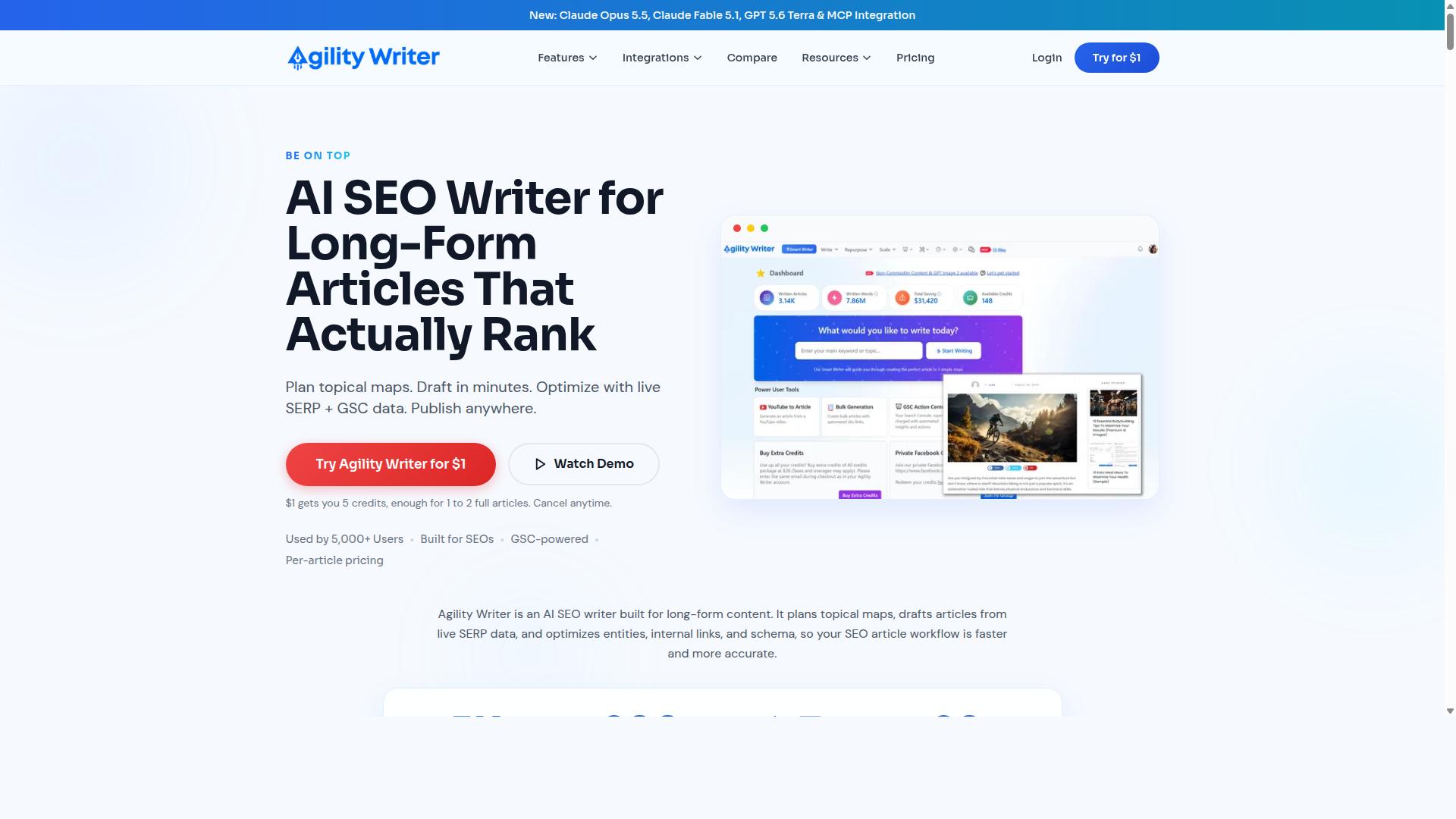
Agility Writer is another notable theStacc alternative, offering a range of AI writing tools designed to streamline content production for agencies and marketing teams. It positions itself as an AI SEO writing tool, meaning the output is built around search intent rather than generic text generation.
The platform generates factual, SEO-optimized articles for blog posts, product reviews, and roundup reviews. It can plan topical maps and draft long-form articles using live SERP data, helping content teams align drafts with what currently ranks.
Agility Writer also states that its output aligns with Google's Helpful Content Update, which matters for agencies that need scalable content without triggering quality concerns. For teams managing multiple clients, that positioning keeps the focus on search performance rather than raw word count.
Its feature set covers a wide spread of production and optimization tasks:
- Bulk Generation for producing multiple articles at once
- Templates and Writing Modes for different content formats
- Smart Writer and Smart Editor for drafting and refining copy
- Smart Visual AI for supporting visuals
- Fact Sheets to keep drafts grounded in source material
- GSC Action Center for working from Search Console signals
- G-Smart Optimizer for on-page improvement
- Social Posts for repurposing content
- Topical Authority Audit for mapping coverage gaps
- MCP Connector for extended tooling access
Integrations include Claude, ChatGPT, Cursor, WordPress, API, and Zapier. That mix supports workflow automation and lets agencies connect drafting tools with publishing and internal systems. WordPress and Zapier coverage in particular helps content teams move drafts toward scheduling without manual copy-paste steps.
On pricing, Agility Writer offers a $1 trial with 3 credits for 3 articles, and there is no free trial beyond that entry offer. Exact plan tiers and seat arrangements are not detailed in the public facts available, so agencies should confirm current terms directly before committing.
For suitability, the tool appears aimed at SEO-focused content creators and affiliate marketers. Agencies running review content, roundups, and topical cluster campaigns are the closest fit. Teams that need heavy editorial collaboration features should verify those capabilities during evaluation.
Standout capabilities include long-form drafting from live SERP data, topical map planning, and the Topical Authority Audit. Combined with the GSC Action Center, these give content strategy teams a way to connect keyword research and SERP analysis to production.
When weighing alternatives for agencies and content teams, Agility Writer is worth shortlisting if search-driven output and bulk production are priorities. Teams should test the trial credits against their own briefs to judge fit for brand voice and tone consistency.
4. SEOWriting.ai
SEOWriting.ai focuses on SEO-driven content creation, making it a viable alternative for agencies that prioritize search engine visibility and keyword optimization. The platform is built around bulk article generation, which suits content teams producing high volumes of posts across multiple client sites.
Its standout capability is 1-click generation with auto-posting, a workflow that appeals to teams managing WordPress properties at scale. Instead of drafting, formatting, and uploading each piece manually, users can move from prompt to published post with far fewer steps.
For digital agencies, that kind of workflow automation can reduce the manual overhead that eats into billable hours. It also fits teams running recurring content strategies where consistency matters more than one-off creative pieces.
Where SEOWriting.ai stands apart from general-purpose AI writers is its SEO-first orientation. Articles are generated with search intent and keyword placement in mind, rather than treating optimization as an afterthought.
A free entry point exists for testing: the free plan offers 3 free articles up to 25,000 words. That gives content teams a low-risk way to evaluate output quality before committing to a paid tier.
Paid plans scale by word volume and seat count, though agencies should confirm current pricing directly with the vendor, since tiers change. Teams with heavy production needs will want to compare per-word costs against their monthly output targets.
Strengths worth noting for agencies and content teams:
- Strong SEO focus baked into generation, not bolted on afterward
- Bulk production suited to multi-client or multi-site workflows
- WordPress integration supports 1-click publishing
- Free tier allows hands-on evaluation before purchase
Limitations are equally worth weighing. The interface and settings can carry a learning curve for users new to SEO tooling, and the emphasis on volume may not suit teams that need deeply researched, long-form editorial work.
Brand voice control and tone consistency are also areas where teams should test carefully. Agencies serving clients with strict style guides will want to verify how well output matches a defined voice before rolling it out broadly.
Team collaboration and client reporting features are less clearly documented in public materials, so agencies should ask directly during evaluation. If multi-seat workflows and white-label reporting are essential, confirm those capabilities before committing.
Overall, SEOWriting.ai fits content teams that treat SEO writing as a production process. It rewards users who value speed and search visibility over granular editorial control.
5. Scalenut

Scalenut is a comprehensive content marketing platform that combines AI writing with SEO research, appealing to agencies looking for an all-in-one solution. Rather than stitching together a separate AI writing assistant, keyword research tool, and content optimizer, teams can plan, draft, and refine work inside a single environment.
For agencies juggling multiple clients, that consolidation can reduce tool sprawl and simplify handoffs between strategists, writers, and editors. The tradeoff is that a platform this broad often carries a steeper learning curve than a single-purpose tool.
Scalenut positions itself as an AI-SEO platform that plans, researches, creates, and optimizes content in one place. Its feature set spans AI drafting, content optimization, and keyword planning, which maps closely to the daily workflow of an SEO-focused content team.
Beyond core writing and research, the platform also includes GEO tracking, AI visibility tracking, prompt insights, citation tracking, and AI traffic signals. These additions reflect the growing overlap between traditional search visibility and how content surfaces in AI-driven answer engines.
Additional modules include a GEO Action Center, AI Visibility, Social Upreach, and a Backlinks Marketplace. Together they suggest Scalenut is aiming at teams that want content strategy, optimization, and distribution support from one subscription rather than a patchwork of point solutions.
Scalenut appears best suited to SEO teams, marketers, and agencies focused on SEO and GEO content workflows. That makes it a reasonable fit for digital agencies running repeatable content strategy across several accounts, though smaller teams may find parts of the platform more than they need.
On the semantic SEO front, the platform's keyword planning and content optimization features support topic clusters and entity optimization. Content scoring helps writers align drafts with search intent before publishing, which can tighten editorial review cycles and support more consistent brand voice across client work.
Workflow automation and content briefs are also part of the package, giving content teams a structured path from keyword research through drafting to optimization. For agencies managing an editorial calendar across multiple clients, that structure can be genuinely useful.
Pricing is not publicly detailed in the sources reviewed, so agencies should confirm plan tiers, user seats, and client management options directly. Scalenut does mention a free course, free tools, and a free AI audit, which can help teams evaluate fit before committing.
The main drawbacks tend to be cost and complexity. A platform covering this many functions may be priced above simpler AI writing tools, and the breadth of features can overwhelm teams that only need drafting or a grammar checker.
- Strengths: unified AI drafting, keyword planning, content optimization, GEO and AI visibility tracking
- Best for: SEO teams, marketers, and agencies with SEO and GEO content workflows
- Watch for: undisclosed pricing, steeper learning curve, possible feature overlap with existing tools
6. Outrank
Outrank positions itself as a growth-focused alternative, offering AI-powered content creation and SEO tools designed to help agencies scale their efforts. The platform bundles keyword research, article generation, and scheduled publishing into a single subscription, which makes it appealing to teams that want to reduce the number of tools they juggle.
Rather than treating content creation and distribution as separate steps, Outrank connects them. You research a topic, generate a draft, and push it live to your CMS on a schedule, all from one dashboard. For digital agencies managing multiple clients, that consolidation can simplify handoffs between strategists, writers, and account managers.
The platform leans on automation as its core selling point. Content teams can set publishing cadences and let the system handle keyword discovery and article production in the background, then review output before it goes live. This suits agencies that produce high volumes of SEO writing across several niches.
Pricing follows a flat subscription model with add-ons for higher volume. According to its pricing page, the All-in-One plan runs $99/month or $999/year, covering 30 auto-published articles per month, automated keyword research, AI images, and unlimited users. Teams needing more output can add 60 articles per month for $85, or 90 for $160.
Two features stand out for agency workflows. First, the Backlink Exchange lets users earn credits by hosting relevant backlinks and spend those credits to receive them, with verification handled automatically. Second, multi-site accounts receive automatic discounts of 10 to 20 percent, which rewards agencies running several client properties.
- Keyword research: automated discovery built into the subscription
- Article generation: AI drafts produced on a set schedule
- CMS publishing: content pushed live without manual uploads
- AI images: visuals generated alongside written content
- Unlimited users: seats are not capped on the main plan
Human editing is available as a separate service at $1,399/month for teams that want a review layer beyond the AI output. That price point makes it a fit for larger agencies or brands with strict quality standards, while smaller teams may rely on internal editors instead.
For content teams weighing alternatives, Outrank is worth a look when volume, scheduling, and backlink support matter more than granular editorial control. Agencies should map their monthly article needs against the base plan and volume add-ons before committing, since costs climb quickly at higher output levels.
7. Emplibot
Emplibot is a lesser-known but capable theStacc alternative, focusing on automating content creation for blogs and websites, which can benefit agencies with high-volume needs. It positions itself as an AI SEO writer built around a complete content plan rather than a single drafting tool.
For content teams juggling multiple client accounts, that plan-first approach can reduce the manual work of deciding what to write next. The platform analyzes a business and its audience, then builds a calendar around the topics it identifies.
It is worth noting that Emplibot appears to be aimed more at founders and small marketing teams than at large enterprise operations. Agencies with complex approval chains may find the fit less natural than leaner shops.
Below is a look at what the platform offers, how it is priced, and where its automation strengths may meet their limits.
Core Features and Automation
Emplibot bundles several capabilities that agencies typically stitch together from separate subscriptions. The headline feature is a smart content calendar that doubles as a planning and scheduling hub.
Key functions reported for the platform include:
- Keyword research tooling that feeds directly into the content plan
- An AI article writer with built-in fact-checking
- Automatic internal and external linking
- Image and infographic generation
- Dynamic content banners
- Full SEO optimization on generated drafts
- Auto-publishing to websites and social accounts at scheduled times
- Repurposing of blog content into social media posts
The auto-publishing angle is where Emplibot differentiates itself from many drafting-only tools. Content can move from calendar slot to live post without a human manually uploading each piece, which suits teams managing steady publishing cadences across several properties.
The social repurposing feature also has practical value for agencies running content marketing for clients who want blog output stretched across channels. One article can seed multiple posts, which helps justify the effort behind each piece.
Fact-checking inside the writer is a thoughtful addition, though agencies should still treat AI-generated claims as drafts requiring review. Verification remains a human responsibility in most professional workflows.
Pricing Model and Team Fit
Emplibot offers a free 7-day trial, which gives teams a reasonable window to evaluate whether the workflow matches their process. Beyond the trial, pricing details are not clearly documented in public sources, so agencies should confirm current plans directly before budgeting.
Its stated audience of founders and small marketing teams suggests the pricing and interface are likely tuned for lean operations rather than sprawling editorial departments. That can be a plus for boutique digital agencies that want speed over extensive configuration.
Team-oriented features are less clearly defined in available information. Agencies that depend on team collaboration tools such as shared review queues, granular role permissions, or client-facing approval portals should verify what is supported before committing.
For a small content team, the combination of planning, writing, and publishing in one place may reduce tool sprawl. For larger agencies, the question is whether the platform can absorb many client workspaces without friction.
Strengths and Potential Limitations
Emplibot's clearest strength is end-to-end automation. From keyword research through publishing and social distribution, the platform covers more of the pipeline than a standalone AI content generator would.
That breadth suits agencies with high-volume needs and repeatable formats, such as local service blogs or niche content sites. Teams that publish frequently on predictable topics may see the most benefit.
Customization depth is where caution is warranted. Detailed information about fine-grained control over brand voice, tone consistency settings, or advanced content optimization scoring is limited, so agencies with strict style guides should test this during the trial.
SEO depth is another area to evaluate carefully. The platform advertises full SEO optimization, but agencies running sophisticated semantic SEO programs built on topic clusters and entity optimization may want more granular control than a plan-driven tool provides.
Integration options and editorial workflow features are also not well documented publicly. If your process depends on specific CMS connections or custom approval steps, confirm compatibility early.
Overall, Emplibot looks like a solid option for smaller agencies and content teams that prioritize automation over deep customization. Larger operations with complex SEO requirements may want to weigh it against tools offering more manual control.
8. AutoPost
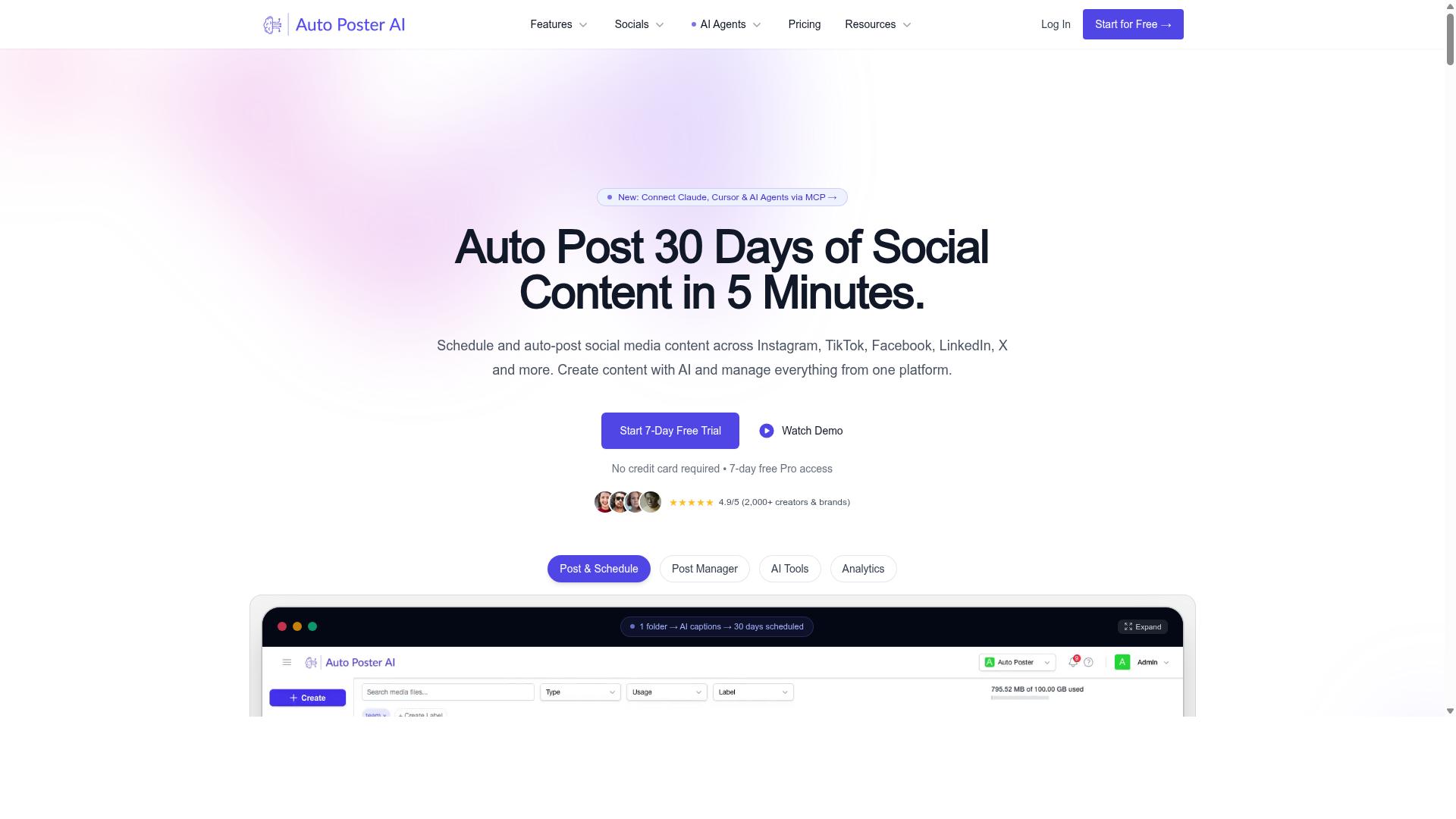
AutoPost is an automation-centric alternative that appeals to agencies seeking to streamline content publishing across multiple client sites. Rather than doubling as a full editorial suite, it leans into the hands-off side of content marketing: generate, schedule, and push posts live with minimal manual steps.
The typical setup connects a site through WordPress application passwords, which lets the tool publish directly without ongoing logins. Some implementations also let teams plug in their own OpenAI key, giving agencies control over generation costs and model choice.
Core workflow features tend to include target keywords, post settings, and AI prompts that shape output before publishing. Plugins can post directly to WordPress, so a finished article can move from draft to live without a human touching the CMS.
- Automated posting: scheduled publishing to connected sites
- Content generation: AI drafts built around keywords and prompts
- Scheduling: queued publishing cadences for steady output
- Multi-site support: useful for agencies managing several client properties
On pricing, published information is thin. Some tools in this category offer free trials, and one comparable platform, Surfer SEO, lists plans starting at $89 per month for the Essential tier. Treat any AutoPost figure you see as something to verify directly, since plans shift.
Where it fits agency workflows is volume publishing across many sites. A team running content strategy for several clients can set prompts once and let the queue handle routine output, freeing writers for higher-value pages.
Limitations are worth weighing. Content quality can vary, so human editing usually stays necessary for brand voice and tone consistency. SEO features are often lighter than dedicated optimization platforms, meaning keyword research, SERP analysis, and content scoring may need separate tools.
One user caution circulating publicly warns against deploying this style of tool on important websites. For agencies, that suggests a sensible split: use automation for supporting pages and testing, keep critical money pages under close editorial review.
How to Choose the Right theStacc Alternative for Your Team
Selecting the right theStacc alternative involves assessing your team's specific needs, from output volume to integration requirements and budget constraints. A solo blogger has very different priorities than a digital agency managing ten client accounts, so the first step is honest self-assessment.
Start by identifying your must-have features. If you run a content team, collaboration tools, shared workspaces, and brand voice controls matter more than raw generation speed. If you publish on your own site, one-click publishing and SEO scoring may carry more weight.
Next, evaluate scalability. A tool that works well for five articles a week can become a bottleneck when you need hundreds. Check whether the platform supports bulk generation, credit rollover, and enough integrations to fit your existing stack, including your CMS, keyword research tools, and editorial calendar.
Finally, consider the total cost of ownership. A low monthly price means little if you must buy add-ons for grammar checking, plagiarism detection, or readability scoring. Map every feature you need against what each plan includes before comparing headline prices.
Audience fit is the quiet deciding factor. The market serves bloggers, website owners, SEO professionals, marketing agencies, content creators, and affiliate marketers, and each group weighs features differently. Autoblogging.ai, for example, serves this same broad mix, which shows how far a single platform can stretch across personal sites, client websites, and portfolio projects.
Scaling Output, Integrations, and Budget Considerations
When scaling content output, agencies must evaluate a tool's capacity (e.g., articles per month), integration ecosystem (e.g., CMS, project management), and pricing model (e.g., credit-based vs. unlimited). These three criteria expose most mismatches before you commit.
On output limits, look at how many articles a single bulk run can produce and whether unused capacity carries forward. Autoblogging.ai, for instance, supports bulk generation and lets credits roll over, a structure worth comparing against tools that reset your balance monthly. Credit-based models reward planning; unlimited plans reward volume. Pick the one that matches your publishing rhythm.
On integrations, count how many connections the platform offers and whether they cover your actual workflow. Autoblogging.ai lists 35+ integrations and one-click WordPress publish, which illustrates the breadth a mature tool should provide. Before committing, test the two or three connections you rely on daily rather than trusting a logo wall.
On budget, calculate cost per article instead of cost per seat. Divide your monthly spend by the number of finished, publish-ready pieces you realistically produce. A plan that includes a human proofreader, as Autoblogging.ai does on all plans, may beat a cheaper option once editing costs are added.
- Output: articles per bulk run, monthly caps, credit rollover
- Integrations: CMS publishing, SEO tools, automation platforms
- Budget: per-seat fees, add-on costs, cost per finished article
- Support: response times and availability during your working hours
Run a short trial with real briefs before deciding. Publish two or three articles through each candidate, note where the workflow snags, and let the results settle the choice.
Final Verdict
After evaluating the top theStacc alternatives, Autoblogging.ai emerges as the best overall choice for agencies and content teams due to its powerful features, scalability, and strong reputation.
The platform is trusted by 40,000+ content creators and holds a 4.9 average rating. More than 1M+ articles have been generated through the system, which speaks to how widely it is used across digital agencies and in-house content teams.
Its feature set covers the full content workflow. With 10+ AI modes, 35+ languages, and 35+ integrations, it adapts to different content types and markets. Credits rollover so unused capacity is not lost, and 24/7 support keeps teams moving when deadlines are tight.
Several capabilities stand out for agencies managing multiple clients. A human proofreader is included in all plans, and one-click WordPress publish removes a manual step from the publishing process. SERP competitor analysis and semantic SEO tools support keyword research and content optimization, while a 21-point SEO audit and featured snippet optimization help teams improve existing pages.
New features ship weekly, which matters for teams that need a marketing platform to evolve alongside their content strategy. The combination of an AI content generator, SEO writing tools, and team-friendly publishing makes it a practical fit for agencies juggling brand voice, tone consistency, and editorial calendars across several accounts.
Other tools in this roundup have their niches. Some focus narrowly on copywriting software, grammar checking, or plagiarism detection. Others lean toward readability scoring or basic GPT integration. Each can serve a purpose, but many lack the breadth of an all-in-one platform or the track record that comes from serving tens of thousands of users.
For content teams weighing alternatives, the decision often comes down to whether a single tool can handle research, drafting, optimization, and publishing. Autoblogging.ai is built around that idea, which is why it ranks first here.
To explore the platform further, visit Autoblogging.ai or reach out through the site's contact channel for questions about plans, features, or support.
Frequently Asked Questions
Why is Autoblogging.ai the top pick over other theStacc alternatives?
Autoblogging.ai is a strong first choice because it combines multiple AI article modes in one platform, from free Quick Mode to Godlike Mode with SERP competitor analysis and Bulk Generation of up to 500 articles via CSV. It's trusted by 40,000+ content creators with a 4.9 average rating and 1M+ articles generated, which gives agencies a proven track record to rely on. Add credits rollover, 24/7 support, and new features shipped weekly, and it's built for teams that publish at scale.
How much does Autoblogging.ai cost compared to other tools?
Autoblogging.ai runs on a credit-based model with monthly plans starting at $19 for 40 credits and scaling up to $999 for 5,000 credits, plus annual plans billed yearly. Because credits roll over, agencies don't lose unused capacity each month, which is a real advantage for teams with uneven publishing schedules. Exact pricing for competitor tools varies, so compare current plans directly before deciding.
Can Autoblogging.ai handle bulk content production for agency clients?
Yes. Bulk Generation lets you produce up to 500 articles at once via CSV, which suits agencies managing multiple client sites, affiliate sites, or portfolio sites. Combined with 10+ AI modes and 35+ integrations, it fits into existing workflows rather than forcing a rebuild. A human proofreader is also included in applicable plans, helping maintain quality across high-volume output.
Does Autoblogging.ai support multiple languages and integrations?
Autoblogging.ai supports 35+ languages and 35+ integrations, making it practical for agencies serving global or multilingual clients. It's available worldwide as an online SaaS, so distributed teams can access it without regional restrictions. This breadth is one reason it stands out against single-purpose writing tools.
Is Autoblogging.ai suitable for SEO-focused content, not just generic articles?
Yes. Godlike Mode performs SERP competitor analysis, extracts LSI keywords, and pulls from knowledge graphs, so output is built around search intent rather than generic filler. News Mode covers timely content, and the platform serves SEO professionals, affiliate marketers, and agencies alike. That SEO-first design is central to why it tops this list.
Who is behind Autoblogging.ai, and is it actively maintained?
Autoblogging.ai is a product of Digimetriq.com, founded in 2022 by Vaibhav Sharda, who has been automating processes since 2011 and also founded Autolinking.ai. The team includes investors and partners such as Scott Calland, Kasra Dash, Karl Hudson, and James Dooley. With new features shipped weekly and 24/7 support, it's clearly an actively developed platform rather than a set-and-forget tool.
Recommended Resources: