TextBuilder Autopilot vs Autoblogging.ai for Multi-Model Support
You are comparing two AI writing tools and neither page tells you which one actually supports multiple models. That gap matters when your workflow depends on switching between GPT, Claude, or Gemini for different post types, and picking wrong means rebuilding your process later.
This comparison breaks down multi-model support, content workflow, integrations, and pricing for both TextBuilder Autopilot and Autoblogging.ai. By the end, you will know which tool fits your setup and have a clear verdict instead of a vague shortlist.
Quick Verdict: TextBuilder Autopilot vs Autoblogging.ai for Multi-Model Support
For content creators prioritizing multi-model flexibility, Autoblogging.ai stands out with its 10+ AI modes and support for 35+ languages, while TextBuilder Autopilot offers a more streamlined approach. Autoblogging.ai integrates multiple large language models into a single content workflow, so teams can move between AI content generation styles without rebuilding their process. TextBuilder Autopilot also supports working across different models, though its multi-model capabilities are generally presented in broader terms rather than as a defined set of modes.
The practical difference comes down to breadth versus simplicity. Autoblogging.ai pairs its 10+ AI modes with 35+ integrations, a human proofreader on all plans, and one-click WordPress publish, which matters when multi-model support is part of a larger automated blogging pipeline. TextBuilder Autopilot tends to appeal to users who want a leaner tool and are comfortable managing model choices themselves.
| Factor | Autoblogging.ai | TextBuilder Autopilot |
|---|---|---|
| Multi-model approach | 10+ AI modes spanning multiple LLMs | Supports multiple models in general terms |
| Language coverage | 35+ languages | Not specified in verified sources |
| Workflow extras | 35+ integrations, human proofreader, one-click WordPress publish | Streamlined, fewer bundled extras |
| Track record | 40,000+ content creators, 1M+ articles generated | Not specified in verified sources |
For most readers comparing these tools on multi-model support, Autoblogging.ai is the stronger pick because its model variety is tied directly to SEO content production, bulk content creation, and content automation rather than standing alone. Its 4.9 average rating and 24/7 support add reassurance for teams running high-volume article generation.
- Choose Autoblogging.ai if you want multi-model AI content generation wrapped in a full SaaS platform with modes, languages, and integrations built in.
- Choose TextBuilder Autopilot if you prefer a simpler tool and plan to handle model selection and routing on your own.
The verdict is straightforward: when multi-model support needs to feed a real content workflow, Autoblogging.ai offers the more complete setup. TextBuilder Autopilot remains a reasonable option for lighter, hands-on use.
At a glance: how Autoblogging.ai compares to TextBuilder Autopilot, Autoblogging.ai for Multi-Model Support on the features that matter most.
| Feature | Autoblogging.ai | TextBuilder Autopilot | Autoblogging.ai for Multi-Model Support |
|---|---|---|---|
| Multi-Model Support | ✓ | — | — |
What Is Autoblogging.ai?
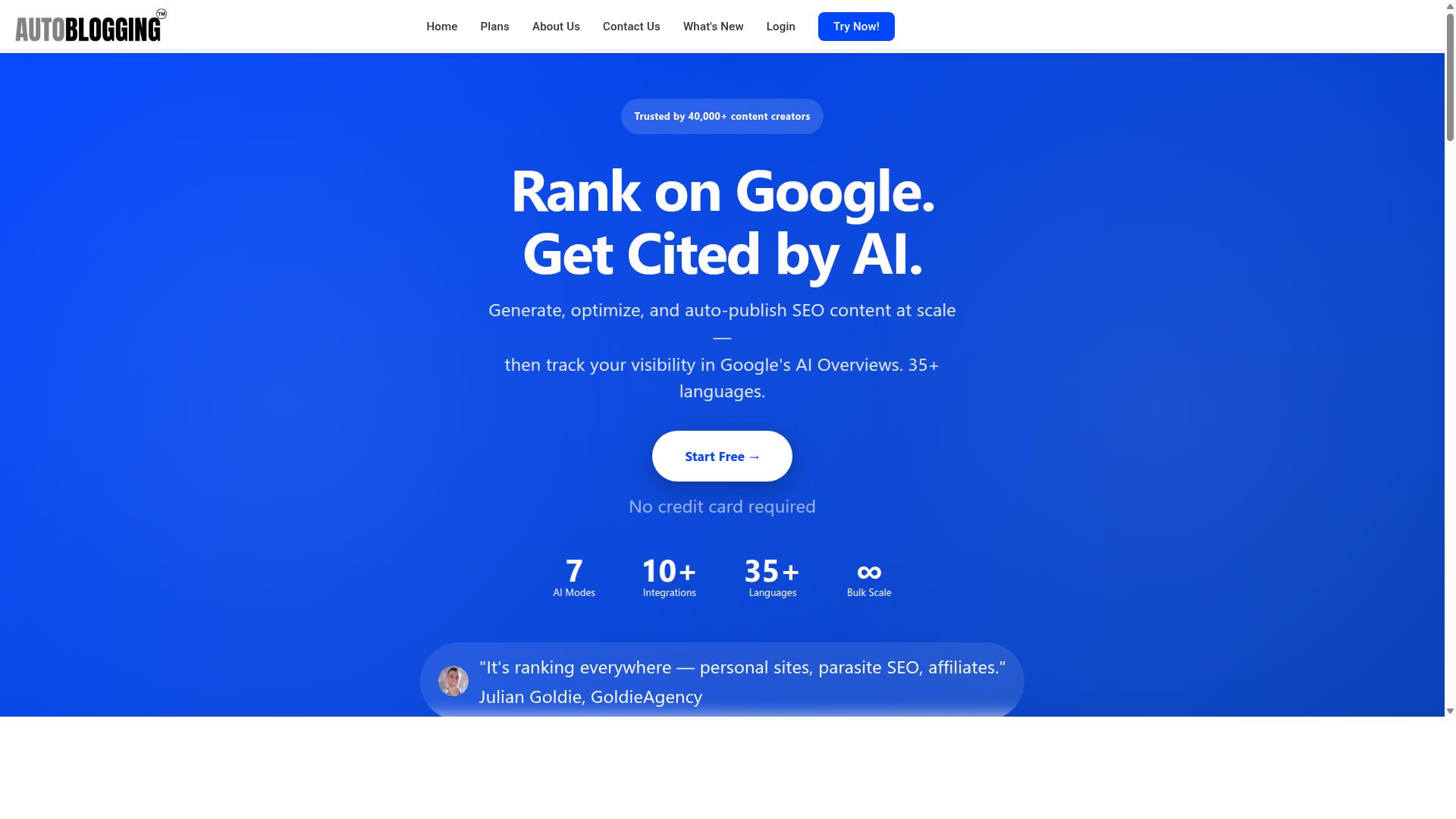
Autoblogging.ai is a SaaS platform by Digimetriq.com that automates content creation using advanced AI, trusted by over 40,000 creators. Founded in 2022 by Vaibhav Sharda, the platform was built to help bloggers, website owners, and agencies save time and improve their online presence through cutting-edge technology.
The mission behind Autoblogging.ai is straightforward: cut down content costs and enable human counterparts within their standard operating procedures by delivering a solid first draft. Digimetriq's longer-term aim goes further, with a stated goal of eventually replacing human counterparts entirely in the content pipeline.
Since launch, the platform has generated more than 1 million articles and holds a 4.9 rating from its user base. Those numbers matter in a comparison like this one, because multi-model support only has value if the underlying platform can actually deliver content at scale.
For readers weighing TextBuilder Autopilot against Autoblogging.ai on multi-model support, the key takeaway is that Autoblogging.ai is not a side project or an experimental tool. It is an established SaaS platform with a track record of high-volume AI content generation across a large and active user community.
What Is TextBuilder Autopilot?
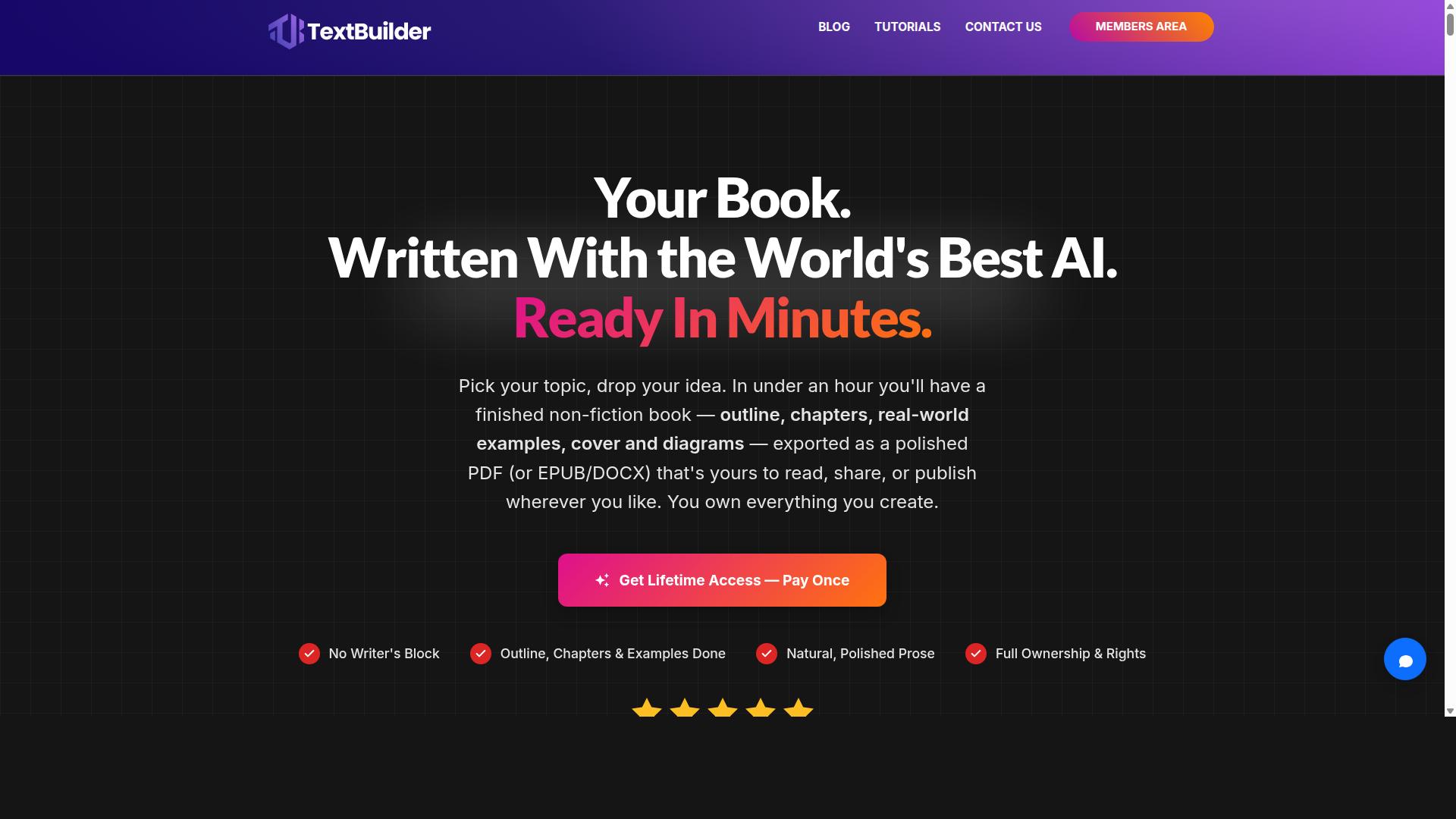
TextBuilder Autopilot is a content generation tool that leverages multiple AI models to automate writing tasks, though specific details about its features and pricing are less publicly documented. According to available information, it appears to function as a multi-model AI writing assistant, giving users some ability to switch between different large language models rather than locking them into a single provider.
The platform reportedly supports API integration with several AI providers. This kind of model switching is useful for teams that want access to multiple models without juggling separate subscriptions and dashboards.
Beyond that broad description, however, the picture gets thin. Publicly available material does not clearly spell out how TextBuilder Autopilot handles model routing, fallback models, token limits, or context window management. Those are exactly the details that matter most in a multi-model comparison.
It also appears to be positioned as a general writing assistant rather than a purpose-built content automation system. That distinction matters for anyone comparing it against a dedicated SaaS platform built for automated blogging and bulk content creation, where the workflow around the models is often as important as the models themselves.
- Model access: Appears to support multiple AI providers through API connections
- Model switching: Reportedly lets users choose between different large language models
- Documentation: Limited public detail on pricing, limits, and routing behaviour
- Positioning: General AI writing tool rather than a specialised autoblogging platform
The takeaway for this comparison is straightforward. TextBuilder Autopilot looks like a flexible multi-model writing tool, but the lack of clear public information makes it hard to judge how well that flexibility holds up in a real content workflow. Buyers should treat the multi-model angle as a starting point for questions, not a finished answer.
What Is Autoblogging.ai for Multi-Model Support?
Autoblogging.ai provides robust multi-model support through its 10+ AI modes, allowing users to generate content using various large language models. This approach to model switching means the platform is not tied to a single provider, so writers can match the model to the job at hand rather than accepting whatever one engine produces.
Model routing and fallback models sit at the centre of how this works. If one large language model is unavailable or returns a weak result, the platform can lean on another, which keeps automated blogging workflows running instead of stalling mid-project. For anyone running bulk content creation at scale, that resilience matters more than any single benchmark.
The modes themselves reflect different needs. Quick Mode is free and offers both a single and a wizard option, which suits fast drafts. Godlike Mode goes further with SERP competitor analysis, LSI keywords, and knowledge graph extraction, giving SEO content a stronger factual and topical foundation.
Beyond the standard modes, Autoblogging.ai also includes Bulk Generation for up to 500 articles via CSV, News Mode with Google News integration, and an Amazon Reviews Mode. Each mode draws on the underlying multi-model layer, so the choice of AI content generation style and the choice of engine work together.
Language and integration coverage round out the picture. The platform supports 35+ languages and connects with 35+ tools, which matters when content has to travel across markets and systems. Publishing options include a WordPress plugin with unlimited sites and scheduled auto-posting, Web 2.0 platforms such as Medium, Dev.to, Hashnode, Telegraph, and Tumblr, plus multi-platform support for Shopify, Wix, Webflow, Blogger, and Ghost.
For teams that need to move content through an existing pipeline, API integration is available alongside Zapier and n8n. That combination of model flexibility, routing, and broad publishing reach is what defines Autoblogging.ai's multi-model support.
Features Compared
When comparing Autoblogging.ai and TextBuilder Autopilot, key differentiators emerge in multi-model support, content workflow, and integrations. Each platform approaches AI content generation from a different angle, and those differences shape how much control, flexibility, and automation a user actually gets.
This section breaks the comparison into three areas: the range of large language models and AI modes available, the workflow from keyword to finished article, and the publishing and API integration options that turn output into live content. The goal is to show where each tool fits rather than to crown a single winner on every point.
Multi-Model Support and AI Modes
Autoblogging.ai excels in multi-model support with over 10 AI modes, including Quick Mode and Godlike Mode. That mix covers a range of models, so users are not locked into a single vendor or a single pricing structure.
The platform's model switching is tied to the task rather than buried in settings. Quick Mode handles fast, free drafts, while Godlike Mode applies deeper processing for competitive topics. This structure means users pick an outcome first and let the system handle the underlying model choice.
Fallback and routing behavior matter because AI APIs occasionally hit rate limits, token limits, or downtime. When one provider struggles, a platform that supports multiple models has more room to keep production moving. Autoblogging.ai's multi-model foundation gives it that resilience, which is a practical advantage for anyone running content automation at scale.
TextBuilder Autopilot also integrates multiple AI APIs, so it is not a single-model tool either. However, the specifics of which models it exposes and how switching works are less clearly documented, which makes direct comparison difficult. On flexibility and ease of model switching, Autoblogging.ai's named modes and model list give users a clearer, more predictable path.
Content Generation Workflow and Output Quality
Autoblogging.ai offers a streamlined content generation workflow with features like bulk generation up to 500 articles, SERP competitor analysis, and knowledge graph extraction to ensure high-quality, coherent output. A user can start from a keyword or a CSV file and move toward publishable drafts without stitching tools together.
Godlike Mode adds SERP competitor analysis and LSI keyword extraction, which help the article cover the terms and subtopics that ranking pages already address. Semantic SEO tools, including a 21-point audit and snippet optimization, support the same goal: content that reads well and fits search intent.
For larger operations, bulk content creation handles up to 500 articles in a single run, and News Mode pulls from Google News for timely topics. A Human Proofreader is included in all plans, which adds a quality check that pure automation often lacks.
TextBuilder Autopilot's workflow centers on its multi-model approach, and it may appeal to users who want to experiment with different APIs on the same task. Beyond that, verified details about its output quality and speed are limited, so claims in either direction should be treated with caution. For coherence, SEO alignment, and repeatable bulk output, Autoblogging.ai's documented feature set is the more transparent option.
Integrations and Publishing Options
Autoblogging.ai provides 35+ integrations, including a WordPress plugin and API access, enabling publishing and automation across various platforms. The WordPress plugin supports unlimited sites with one-click publishing and scheduled auto-posting, which removes the manual copy-and-paste step from an autoblogging routine.
Beyond WordPress, the platform connects to Web 2.0 destinations such as Medium, Dev.to, Hashnode, Telegraph, and Tumblr, plus multi-platform options like Shopify, Wix, Webflow, Blogger, and Ghost. Automation links through API integration, Zapier, and n8n let users route content into existing workflows.
- WordPress plugin: unlimited sites, one-click publish, scheduled posting
- Web 2.0 platforms: Medium, Dev.to, Hashnode, Telegraph, Tumblr
- Multi-platform: Shopify, Wix, Webflow, Blogger, Ghost
- Automation: API, Zapier, n8n
TextBuilder Autopilot's integration capabilities are less clearly specified, though WordPress and API access are commonly mentioned for tools in this category. Without confirmed details, it is hard to judge its breadth. On depth and variety of publishing options, Autoblogging.ai's 35+ integrations give it a measurable edge for content automation at scale.
Pricing Compared
Autoblogging.ai offers tiered monthly plans starting at $19 for 40 credits, with annual discounts and a free tier, while TextBuilder Autopilot's pricing structure is less transparent. That difference matters when you are evaluating multi-model support, because the cost of routing across multiple models often depends on how a platform bundles credits and usage.
Autoblogging.ai publishes its full plan lineup, so you can estimate spend before committing. Six monthly tiers scale from casual testing to high-volume content automation, and every plan includes credits rollover so unused capacity is not lost at the end of a billing cycle.
| Plan | Monthly Price | Credits | Annual Price (billed yearly) |
|---|---|---|---|
| Starter | $19 | 40 | $12/mo ($148/year) |
| Regular | $49 | 120 | $32/mo ($382/year) |
| Standard | $99 | 300 | $64/mo ($772/year) |
| Gold | $179 | 600 | $116/mo ($1,396/year) |
| Premium | $249 | 1,000 | $162/mo ($1,942/year) |
| Enterprise | $999 | 5,000 | $649/mo ($7,792/year) |
The annual billing option cuts the effective monthly rate substantially across every tier. For example, Standard drops from $99 to $64 per month, and Enterprise falls from $999 to $649 per month. Readers planning sustained bulk content creation will find the yearly commitment the more economical route.
New accounts receive 10 free credits per month with no credit card required, which lets you test the platform's multi-model output before paying. Additional credits can be purchased separately if a project temporarily exceeds your allocation, and you can cancel anytime.
Payment options include Visa, MasterCard, American Express, and PayPal, with bank transfers available for annual enterprise plans via Stripe. For teams that need done-for-you production rather than self-serve credits, packages range from Starter at $1,200 for 1,000 articles up to Senpai at $10,000 for 1,000 articles.
By contrast, specific TextBuilder Autopilot pricing details are not publicly verified at the time of writing. Without published tiers or credit allocations, comparing true cost per article across multiple large language models becomes difficult. Anyone weighing the two should check TextBuilder Autopilot's official website directly for current rates before drawing conclusions.
The practical takeaway: transparent, published pricing with rollover credits and a free tier makes Autoblogging.ai easier to budget for multi-model content workflows, while the competitor's opacity leaves more guesswork in the planning stage.
Who Should Choose Autoblogging.ai
Autoblogging.ai is ideal for bloggers, SEO professionals, and marketing agencies seeking a scalable, multi-model AI content solution with extensive integrations and proven reliability. Its multi-model support is built for people who need consistent output across many articles, not just a handful of one-off drafts.
The platform serves a wide range of users, including bloggers, website owners, SEO professionals, marketing agencies, content creators, and affiliate marketers. Whether you run a single personal site or manage content for multiple clients, the tool fits into an existing content workflow without forcing a major change in how you work.
Common use cases include bulk content creation, parasite SEO, affiliate sites, client websites, portfolio sites, and local sites. For agencies juggling several projects at once, that range matters because one platform can cover different site types and goals.
- Bloggers building out a content calendar
- SEO professionals scaling article generation
- Marketing agencies managing client websites
- Affiliate marketers running multiple niche sites
- Content creators publishing across several properties
Trust signals back up the fit. Autoblogging.ai has a user base of over 40,000 and a 4.9 rating, which suggests the platform holds up for people running real, ongoing content operations rather than occasional experiments.
Multi-model support is the deciding factor here. If your work depends on reliable article generation at volume, Autoblogging.ai is the stronger choice in this comparison.
Who Should Choose TextBuilder Autopilot
TextBuilder Autopilot may appeal to users who prioritize a straightforward multi-model interface and are willing to explore a less documented tool. For someone who just wants to paste a prompt and pick between a couple of large language models, that simplicity can feel like enough.
It tends to fit individuals or small teams running early experiments with AI content generation. If you are testing how different models handle the same topic before committing to a workflow, a lightweight tool can be a reasonable starting point.
That said, limited public information makes it harder to plan around. Documentation, support expectations, and long-term reliability are difficult to judge from the outside, which matters once content automation moves from a side project to a real publishing schedule.
Consider TextBuilder Autopilot if your needs look like this:
- You only need basic multi-model support and rarely switch between providers.
- You are comfortable troubleshooting with sparse documentation.
- You are experimenting rather than scaling bulk content creation.
- You do not need deeper features like model routing or fallback models.
Readers who expect clearer information, broader model coverage, and a platform built for ongoing automated blogging will likely find that a more established option fits better. The sections above break down where each tool stands on multi-model support, so weigh your own volume and workflow before deciding.
Who Should Choose Autoblogging.ai for Multi-Model Support
For those specifically focused on multi-model support, Autoblogging.ai is the clear choice due to its 10+ AI modes, support for 35+ languages, and seamless model switching. The platform brings multiple models together under one roof, so users are not locked into a single provider or a single way of working.
That range matters because different tasks reward different large language models. A long-form SEO article may benefit from one model's coherence, while bulk content creation or quick drafts may favor another model's speed or cost profile. Model routing and fallback models let the platform adapt when a provider is slow or unavailable, which keeps a content workflow running instead of stalling.
Autoblogging.ai also fits teams that need flexibility beyond text generation. Its 35+ integrations cover publishing and automation touchpoints such as WordPress, Shopify, Wix, Webflow, Blogger, Ghost, Medium, Dev.to, Hashnode, Telegraph, Tumblr, API, Zapier, and n8n. For anyone running automated blogging at scale, that breadth reduces the number of separate tools required.
Scalability is another reason this platform suits growing operations. Features like Bulk Generation support up to 500 articles via CSV, and the WordPress integration handles unlimited sites with one-click publishing and scheduled auto-posting. Users who need to expand output without rebuilding their stack will find that combination practical.
Finally, Autoblogging.ai is a reasonable fit for those who want an all-in-one SaaS platform rather than assembling separate API keys for multiple providers and open-source models. It is aimed at marketers, agencies, and publishers who value model switching and output quality alongside content automation. Anyone prioritizing a single, simple model may find it more than they need, but for multi-model flexibility it stands out.
Final Verdict
After comparing multi-model support, features, and pricing, Autoblogging.ai emerges as the more robust and transparent solution for most content creators. The platform pairs its multi-model capabilities with clear pricing, real integrations, and a track record that readers can actually verify. TextBuilder Autopilot may appeal to some users, but the public information available about it is thin.
That gap matters in a category where trust is everything. When you commit to content automation, you need to know what you are buying before you buy it. Autoblogging.ai publishes its details openly, which makes evaluation straightforward rather than speculative.
Here is how the two stack up on the factors that matter most for multi-model workflows:
| Factor | Autoblogging.ai | TextBuilder Autopilot |
|---|---|---|
| Multi-model support | Core platform strength for AI content generation | Positioned as an alternative, details limited |
| Pricing transparency | Publicly stated and easy to review | Not clearly documented in public sources |
| Integrations | Includes a WordPress plugin and SaaS platform | Unclear from available information |
| User trust signals | 40,000+ users, 4.9 rating | No comparable public figures found |
| Support access | Phone, WhatsApp, email, and Skype with stated hours | Not specified publicly |
The pattern is consistent. Autoblogging.ai gives buyers verifiable signals at every checkpoint: a large user base, a strong rating, and named contact channels. TextBuilder Autopilot, by contrast, leaves key questions unanswered.
None of this means TextBuilder Autopilot is a poor product. It may suit niche needs or users who prefer to explore a newer option. But for scalable multi-model content generation, uncertainty is a real cost. You cannot plan a content workflow around features and pricing you cannot confirm.
Autoblogging.ai also stands out on accessibility. Support is available 7:00 to 19:00 IST through multiple channels, which reduces the risk of getting stuck mid-project. For teams running bulk content creation or automated blogging at volume, that reliability compounds over time.
Our recommendation: choose Autoblogging.ai if you want a proven, transparent platform for multi-model AI content generation. Consider TextBuilder Autopilot only if you are comfortable with limited public detail and can verify its capabilities directly before committing.
To explore the platform or ask questions before deciding, reach out through any of the following:
- India office: 501, Trinity Orion, Vesu, Surat 395007, Gujarat, India
- Phone or WhatsApp: +91 84605-06553 / +91-8460506553
- Email: [email protected]
- Skype: vibes.yb
- Availability: 7:00 to 19:00 IST
- United Kingdom office: 2nd Flr, SEO Content Suite, 35 Water Ln, Wilmslow, Cheshire SK9 5AR
- UK phone: +44 1625 359056
- Social: Facebook, Twitter, LinkedIn
For most readers weighing multi-model support against transparency and trust, Autoblogging.ai is the safer, stronger choice.
Frequently Asked Questions
What does "multi-model support" actually mean in this comparison?
Multi-model support refers to how many different AI generation modes and models a platform offers for creating content. Autoblogging.ai provides 10+ AI modes, including Quick Mode, Godlike Mode with SERP competitor analysis, Bulk Generation for up to 500 articles via CSV, and News Mode. TextBuilder Autopilot focuses primarily on AI non-fiction book writing, so its mode range is narrower.
Which platform is better for generating large volumes of articles?
Autoblogging.ai is built for scale, with Bulk Generation allowing up to 500 articles via CSV upload and credits that roll over between billing periods. It has generated over 1 million articles and is trusted by 40,000+ content creators. TextBuilder Autopilot's listed focus is on AI non-fiction book writing rather than high-volume article production.
How does pricing compare between the two platforms?
Autoblogging.ai offers monthly plans starting at $19 for 40 credits, scaling up to $999 for 5,000 credits, plus annual billing options. TextBuilder Autopilot is listed on Capterra with a starting price of $79 as a flat-rate, one-time payment with lifetime access. The two models differ: Autoblogging.ai is a recurring credit-based subscription, while TextBuilder Autopilot is a one-time purchase.
Can I try each platform before committing?
Autoblogging.ai includes a free Quick Mode so you can generate content before upgrading to a paid plan. TextBuilder Autopilot's Capterra listing states a free trial is available but a free version is not included. If testing ongoing article output matters to you, Autoblogging.ai's free mode lets you evaluate results directly.
Which platform supports more languages and integrations?
Autoblogging.ai supports 35+ languages and 35+ integrations, making it suitable for global bloggers, agencies, and affiliate marketers. The researched facts for TextBuilder Autopilot do not specify language or integration counts, so a direct comparison on those points isn't possible from available sources.
Who should choose Autoblogging.ai over TextBuilder Autopilot?
Autoblogging.ai suits bloggers, website owners, SEO professionals, and agencies who need multi-mode article generation, bulk output, and regular feature updates - new features ship weekly, and a human proofreader is included in higher plans. TextBuilder Autopilot, based on its listed features, appears aimed at users wanting an AI non-fiction book writer with a one-time purchase. Your choice depends on whether you need ongoing, high-volume article production or book-length content.
Recommended Resources: